
The Single Edge Notch Test: Griffith Energy Competition in Viscoelastic Elastomers
Published:
My recent work, “The Single Edge Notch Fracture Test for Viscoelastic Elastomers,” was recently published in the Journal of Theoretical, Computational and Applied Mechanics and can be accessed here. Fortunately, the journal is open access, and you can also access the back-and-forth review process here. Personally, I find the review process both entertaining and insightful, and I hope you will find it useful as well.
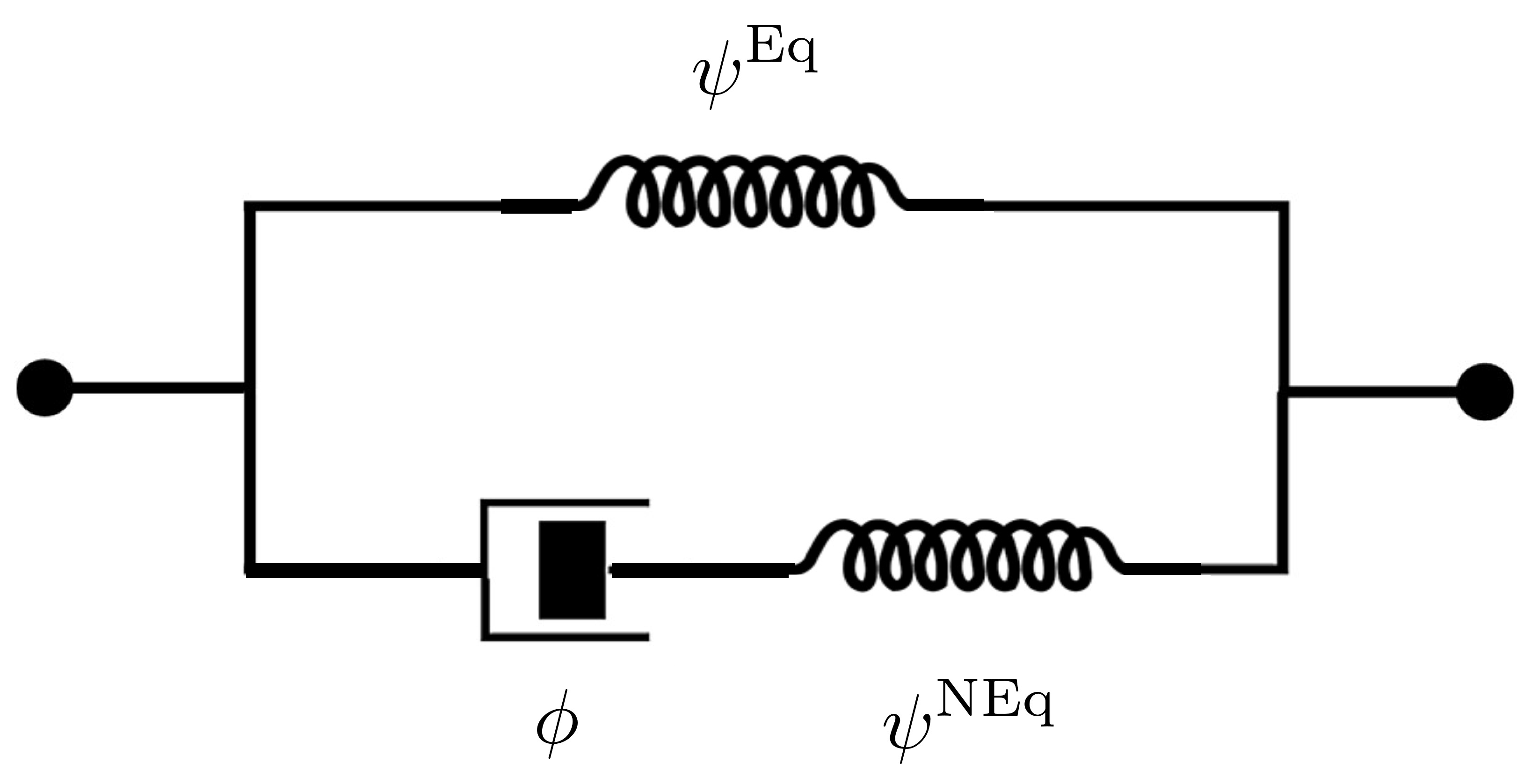
This is also a good place to write down a few notes on the paper. The main purpose of the paper is to investigate the Griffith energy competition in viscoelastic elastomers using the single edge notch test. The conjecture is the following: the only part of the energy that competes with the surface energy is the equilibrium part of the elastic energy. If we consider the rheological model shown here, this conjecture can be written as
\[-\dfrac{\partial \mathcal{W}^{\mathrm{Eq}}}{\partial \Gamma_0}=G_c\]where \(\mathcal{W}^{\mathrm{Eq}} = \int_\Omega \psi^{\mathrm{Eq}} \, d\Omega\) is the equilibrium part of the elastic energy, \(\Gamma_0\) is the crack surface, and \(G_c\) is the critical energy release rate. The validity of this conjecture has been investigated and verified using three different tests, namely the pure shear test, delayed fracture test, and trousers test (see the introduction and references therein for more details).
The single edge notch test is a widely used experimental setup for studying fracture mechanics. One important observation is that, in some cases, the critical stretch at which the crack starts to propagate is not constant and depends on the loading conditions, unlike in the pure shear test, for example.
This observation has led some skeptics to question the validity of the conjecture, as may be inferred from the reviews we received for the paper. The basic argument is that if the criticality depends only on the equilibrium part of the energy, then by changing the loading conditions — for example, the loading rate — the critical stretch should not change, since the viscoelastic part of the material does not enter the competition directly. However, this raises an important question: where does the equilibrium part of the energy come from?
The answer is that the equilibrium part of the energy is determined through the solution of the balance of linear momentum. This means that viscoelasticity affects the equilibrium part of the energy through the balance of linear momentum, albeit in an implicit way. Therefore, by changing the loading rate, the equilibrium part of the energy also changes, and as a result, the critical stretch can change as well. This is a very important point to keep in mind when interpreting the results of the single edge notch test and its implications for Griffith energy competition in viscoelastic elastomers.
In this work, we present a parameter study as well as a comparison with experimental results from the single edge notch test, both of which support the validity of the conjecture while also showing that the critical stretch can vary with the loading rate. The details of the parameter study and the comparison with the experimental results can be found in the paper.